

By Tohru Inoue
(Difficult subject matter)
On a weekend in 2008, when Joy was in primary school, her younger sister was so hungry that Joy went out and borrowed 10 shillings (roughly ten cents) worth of food from the neighbor’s restaurant. When her father came home, and heard what Joy had done, he was furious. He felt she had shamed him in front of the neighbors. Maybe they would think he was unable to provide for his family. He led the children back into the house, tied newspapers on Joy’s hands, poured paraffin on them and on her back, and lit the fuel. She struggled but her father was too strong for her. Joy’s sister was crying but was told to just keep eating her food. Joy struggled and eventually broke free and was found by the neighbours.
She showed me her hands. The burns left noticeable scars across her wrists. The man who had raised her was, in her own words, “a monster.” The scars, much like the memories, can’t be erased.
Her father was taken into police custody. She was physically safe but the ordeal was far from over. Many of her relatives now blamed her for breaking up the family. I asked her what the hardest part was. A flurry of thoughts came out. Her father being in jail; her sister, young as she was having to testify in court; losing a whole year in school with friends for having to attend legal proceedings; feeling like no one wanted her.
She would have ended up in the streets, she says, like many of the youth who fall through the cracks after hard times. She might have ended up an alcoholic like her dad, she says.
“I would have wasted my life.”
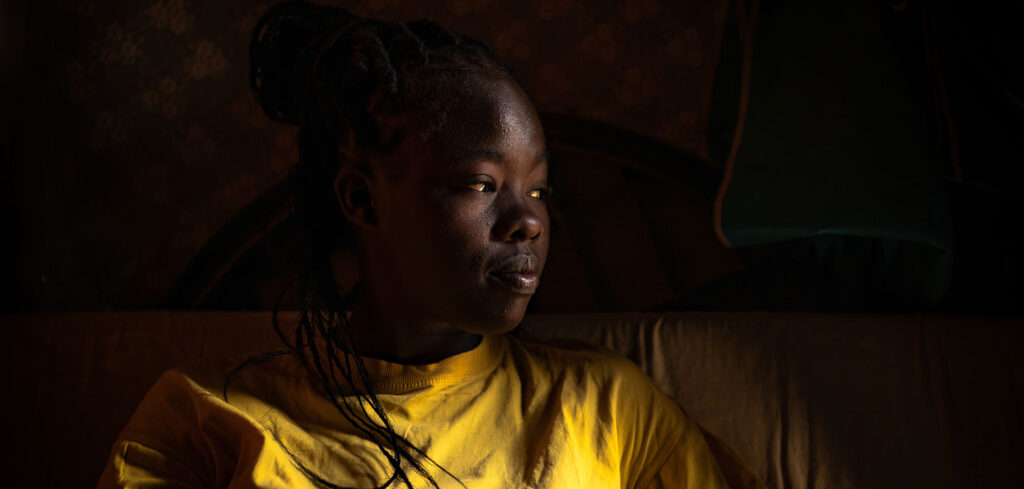
But she was drawn to the sanctuary of the soccer pitch. She had learned to play at a young age. The boys played in their shorts while she wore a dress. It didn’t seem to matter. On the pitch, everyone is accepted. On the pitch, you’re needed. And even if you feel emotionally empty going in, when you receive a pass, it’s like you’re being given the whole world. Someone is entrusting you with the prised object of the whole game. And it’s through the pitch that Joy found God. She saw him in the hands and feet of the coaches, heard his voice when the Scriptures were tossed around in conversation, got to know him through study of his Word and through church.
“God is a life changer,” she remarks. With time, God gave her the strength to forgive her father. She remembers the day.
“When we met… I hugged him and stayed there for a while. And that’s it. It was over.”
God found her father also and he believed in Jesus. Joy’s father is now a different person. He quit drinking, he preaches and gives the family memory verses.
Now, Joy works as a soccer coach with young people. She knows what some of these youth are going through: absent fathers, troubles at home and school.
Some of those kids are finding this pitch after a hard season. They are coming to the pitch after a difficult situation at home. Some of these children come to the pitch carrying their own scars. They’re looking for a safe space where they are needed and accepted. And here on the pitch where she coaches, they are always welcome. This pitch is somewhat of a sanctuary where God is invited and preached. Every time they meet on this sanctuary, Jesus shows up also carrying His scars. Ones that reminds the young people that He’s not given up on them. Joy knows this, and the kids she works with will soon discover this for themselves.
Will you join us in continuing to create safe spaces for young people to encounter the love and truth of Christ? Make a gift here: https://sports-friends.org/give/
We were privileged to also capture Joy’s story in this short film. Take a look!